SF6-Free Switchgear in Offshore Turbines: What the EU 2028 Deadline Means for Dropper Cables
Every offshore turbine with a 66kV array connection has a switchgear cabinet at the tower base, and the dropper cable plugs into it. For years that cabinet was assumed to be SF6-insulated. EU regulation is changing that assumption, and the date that matters for 66kV-class equipment is closer than most procurement calendars reflect.
The Dates
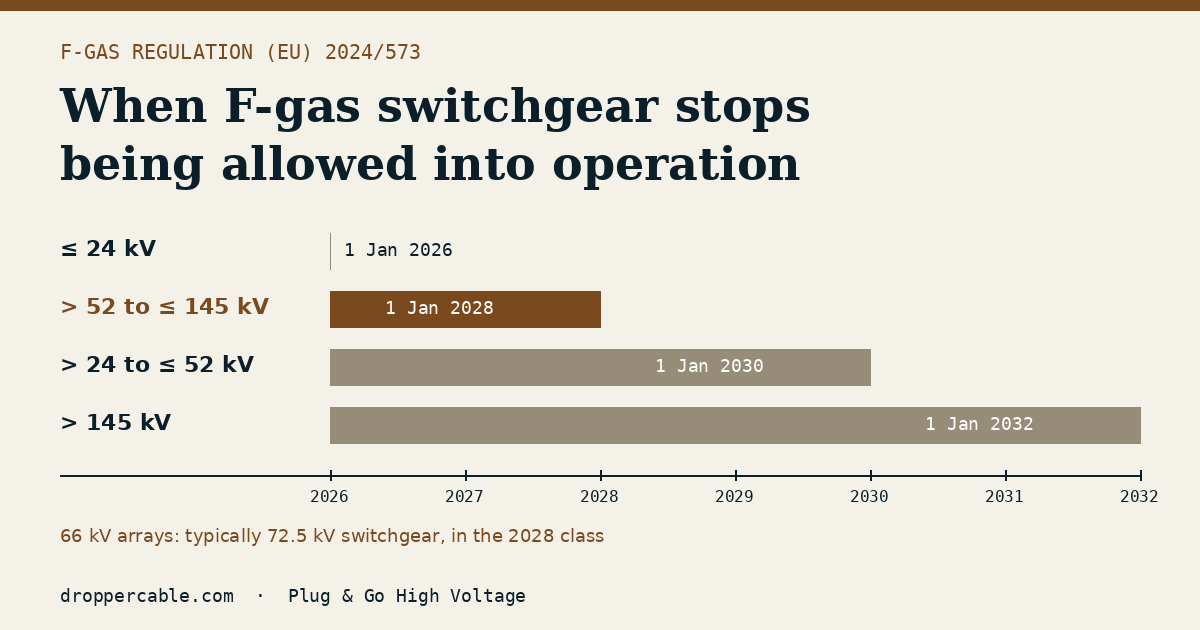
Regulation (EU) 2024/573 on fluorinated greenhouse gases restricts putting new F-gas switchgear into operation, staged by voltage class. Based on ESB Networks’ summary of the rules, corroborated by a Siemens Energy factsheet:
- up to and including 24 kV: from 1 January 2026;
- above 24 kV up to 52 kV: from 1 January 2030;
- above 52 kV up to 145 kV (with short-circuit current up to 50 kA): from 1 January 2028;
- above 145 kV: from 1 January 2032.
Turbine switchgear for a 66kV array is typically rated 72.5 kV, which sits in the third bracket. Two details matter. The restriction applies when equipment is put into operation, understood as handover to the operator, not when it is ordered. And equipment ordered before the regulation entered into force in March 2024 may be exempt if the order date can be evidenced. Both sources are summaries; read the regulation and take legal advice on your project’s position before relying on an exemption.
It Is Already Done in Practice
SF6-free 72.5 kV switchgear is not a laboratory concept. Siemens put its 8VM1 72.5 kV switchgear, insulated with “clean air” (roughly 80% nitrogen and 20% oxygen) and using vacuum interrupters, into service at the Nissum Bredning wind farm in Denmark in 2018. The turbines there connect at 66 kV. The open question for a project is therefore availability and track record for the specific switchgear and rating, not whether it can be done.
What It Means for the Dropper Cable Interface
The dropper cable’s job is unchanged: connect the array cable to the switchgear inside the tower. Seagreen used pluggable, SF6-free joints on a preassembled, pretested cable system for exactly this connection. What can change is the switchgear’s interface, and the dropper cable must match it. The practical questions are:
- Which switchgear is specified for each turbine, and when? The F-gas deadline may force a different cabinet than the one used for previous projects.
- Does the plug-in interface still match? Do not assume a connector qualified for one switchgear design fits another. Confirm dimensions, type-test evidence and who is responsible for the combined assembly.
- Which standard evidences the interface? For gas-insulated switchgear above 52 kV, IEC 62271-209 covers the cable connection and its 2019 edition added a dielectric type test for plug-in terminations. Ask whether the evidence is for the current edition and for the actual combination.
- Is the assembly tested as delivered? A factory test of the dropper cable with its connectors, as in our FAT checklist, remains the cheapest point at which to find a problem.
Procurement Checklist
- Confirm the putting-into-operation date for each turbine against the 1 January 2028 threshold, and whether any exemption genuinely applies.
- Fix the switchgear model before freezing the dropper cable specification.
- Require interface drawings and type-test reports covering the exact switchgear and connector pairing.
- Keep factory testing and after-installation testing in the scope, whichever insulating gas is used.
- Record the decision in the interface control document so a late switchgear change triggers a cable review.
The Takeaway
Insulating gas is a switchgear decision, but its consequences land on the cable. Treat the switchgear choice as a dependency of the dropper cable specification, not a separate workstream. Suppliers of preassembled assemblies such as Reynard, which tests every assembly before shipping, can only match an interface that has been specified.
Sources: ESB Networks — F-Gas Regulation (EU) 2024/573, Siemens Energy — EU F-gas regulation factsheet, T&D World — Wind Farm Places First SF6-Free High-Voltage Switchgear into Operation, PFISTERER SEANEX at Seagreen (Power & Cables).